
Floor Doctor Logo

Epoxy Garage Floors Austin, Texas: Pros, Cons & Real Costs

Posted on May 19, 2026 by Robert Hamm

When you’re considering epoxy garage floors in Austin, Texas, you want real numbers and honest advice. With more than 5.5 months of inventory in Austin’s slower 2026 housing market (Unlock MLS, Q1 2026), a finished garage will help your home stand out. Costs, pros, cons, and what makes a floor stand up to the test of time instead of peeling off in two years are all in this guide.
How Much Do Epoxy Garage Floors Cost in Austin in 2026?

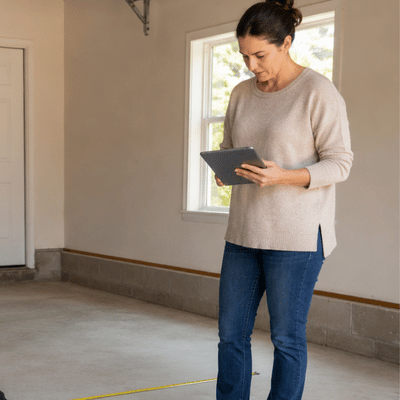
A homeowner reviews garage measurements on a tablet before planning epoxy garage floors Austin Texas installation

Garage flooring in Austin runs a wide range depending on slab condition, system type, and prep work.

Most Austin contractors start a standard two-car flake system around $2,500 for 400 sq. ft., or $6.00–$6.30/sq. ft.

Common add-ons to budget for:

  • Moisture testing: $200–$500
  • Crack and spall repair: $250–$750
  • Concrete removal in Austin, TX (old coating removal): $1.00–$3.00/sq. ft.
  • Moisture mitigation primer: $1–$3/sq. ft.

Bottom line: A two-car garage in Austin starts in the mid-$2,000s for a flake system and rises into the low-to-mid $4,000s with heavier prep or upgraded topcoats.

Pros of Epoxy Garage Floors in Austin

  • Durable. Resistant to abrasion, impact, and most chemical spills from vehicles and tools.
  • Simple to clean. A mop and pH-neutral cleanser are typically sufficient (Sherwin-Williams).
  • It looks fantastic longer. Flake systems cover dirt and wear more well than plain concrete.
  • Improved traction. Flake, quartz, or anti-slip additives enhance grip on glossy surfaces.
  • Resale appeal. A completed garage demonstrates attention to buyers in Austin's competitive market.

Cons of Epoxy Garage Floors Homeowners Should Know

  • Peeling due to prep failures. Epoxy sticks to the slab. No grinding or untreated moisture causes bubbles and delamination.
  • Moisture is the biggest threat. If you have moisture issues with your slabs, Sherwin-Williams recommends in-situ testing per ASTM F2170.
  • UV can yellow clear epoxy. Direct sun at the door can degrade unprotected systems over time.
  • Patching metallic finishes is difficult. Spot repairs are seldom a good match.
  • VOC odor during install. EPA data shows indoor VOC levels run 2–5 times higher than outdoors during coating work. Ask for low-VOC product data sheets.

Why Surface Preparation Matters More Than the Coating Name

Prep determines whether your floor lasts 5 years or 15.

Diamond grinding or shot blasting creates the surface profile that coatings bond to. Sika's U.S. surface-preparation guide states substrates must be structurally sound, clean, and contaminant-free before any resinous system is applied. Acid etching alone is not the professional standard.

For concrete removal in Austin, TX (stripping failed coatings), budget at least $1.00/sq. ft. If a powder stripper in TX is used to soften old coatings, confirm it's followed by mechanical grinding, not used in place of it.

Top reasons coatings fail:

  1. Moisture not tested or mitigated
  2. Oil, grease, or curing compounds left on the slab
  3. Old coatings not fully removed, including jobs where a powder stripper in TX was applied without follow-up grinding
  4. Weak concrete coated over instead of repaired

Reasons Coatings Fail

1

Moisture not tested or mitigated

2

Oil, grease, or curing compounds left on the slab

3

Old coatings not fully removed, including jobs where a powder stripper in TX was applied without follow-up grinding

4

Weak concrete coated over instead of repaired

How Austin's Climate Affects Garage Floor Coatings

Every year, Austin experiences over 122 days with temperatures at or above 90°F (NOAA/NWS). This has two major implications for Austin's garage flooring.

UV and heat: Garages that face south or are open receive a lot of direct sunlight. Topcoats made of polyaspartic or aliphatic polyurethane have UV protection built in. In Austin, UV-stable topcoats are not optional.

Austin receives 36.25 inches of rain yearly. Following a storm, humidity remains high for several days. If your slab has any moist places, request ASTM F2170 testing before construction begins.
How to Choose the Right Garage Floor Contractor in Austin

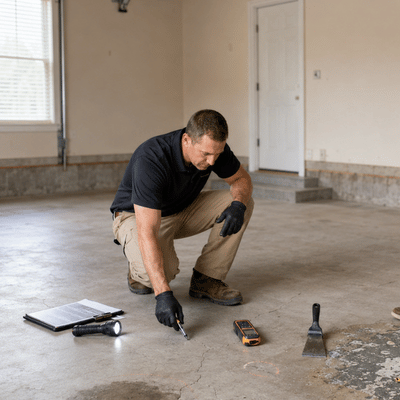
A contractor inspects cracks and surface prep needs before installing epoxy garage floors Austin Texas
  • How do you prep the slab? Strong: diamond grinding or shot blasting. Red flag: acid etch only.
  • Do you moisture-test? Strong: ASTM F2170 RH testing. Red flag: "We just look at it."
  • How do you handle concrete removal in Austin TX? Strong: separate line item at $1+/sq. ft. Red flag: "We coat over most old epoxy."
  • Is the topcoat UV-stable? Must be yes for Austin.
  • What does the warranty exclude? Honest contractors name exclusions clearly.

What is the cost of an epoxy garage floor in Austin?

In Austin, a two-car garage with a full-flake system will generally be around $2,500 in 2026. The final price is driven by slab condition and prep needs.

Which is better for Austin garages: epoxy or polyaspartic?

Both work fine when installed correctly. Polyaspartic is 20–30% more expensive, but it provides better UV stability and a quicker return to service for garages that are exposed to the sun.

How long do epoxy garage floors last in Texas?

A professionally installed system lasts 10–20 years with routine care. Prep quality and moisture management matter more than the resin brand.

Do garage floor coatings peel from hot tires?

Hot tire pickup is more common with thin or low-solids coatings. A well-built professional system with a good top coat minimizes this risk considerably.

Is epoxy slippery when wet?

Wet plain glossy epoxy can feel slippery. Full-broadcast flake, quartz or anti-slip additives improve traction. Ask what texture option your contractor provides.

Should I test for moisture before coating a garage floor?

Yes, particularly if it's an older slab or one with damp patches visible. The recommended method is ASTM F2170 in-situ RH testing.

Floor Doctor has been serving Austin and Central Texas homeowners with epoxy and polyaspartic systems made for local conditions. On every project, we do a full slab evaluation and moisture assessment. Mechanical prep is standard on all jobs. The team explains product specs, cure times, and fair pricing to homeowners before work begins, and applies UV-stable topcoats on all Austin installs. That local knowledge and technical process is why Austin homeowners keep coming back, and why referrals are a big part of the business.

Book your free garage floor assessment with Floor Doctor today and get a detailed quote built around your slab's actual condition, not a generic estimate.

Article written by
Author Avatar
Robert Hamm
Robert is the Floor Doctor expert in elevating residential spaces with decorative concrete refinishing and diamond polishing. He combines an artist's eye with technical precision, specializing in custom, durable, and stylish floor designs for homes, garages, and outdoor living areas across Central Texas.
Copyright 2026 Floor Doctor, LLC. All rights reserved.