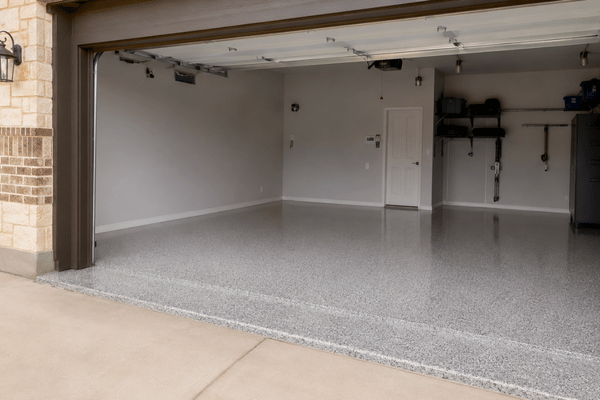
An epoxy garage floor in Fort Worth can make your garage cleaner, stronger, and easier to use. It can resist stains, tire marks, dust, and daily wear when installed the right way. The key is not just the coating. The real results depend on slab prep, moisture checks, crack repair, and the right topcoat for Texas heat.
Fort Worth weather can be tough on garage floors. National Weather Service climate data for the DFW area shows July and August normal highs near 96°F. The area also averages more than 20 days at or above 100°F each year.
That heat counts. So do rain, humidity, and wet tires after a storm. Garages are also used more than in the past. Many homeowners also use them for parking, storage, hobbies, home gyms, and tools.
If you are searching for a garage floor coating in Fort Worth, you need to select one that will work well for the conditions in that area. A simple coating may look good initially, but it can prematurely fail if the concrete is not adequately prepared.
Common problems are:
The best results start with checking the slab before any coating is applied.
The word “epoxy” is often used for many types of garage coatings. In truth, homeowners may be comparing epoxy, polyaspartic, polyurethane, or basic floor paint.
| Coating Type | Main Benefit | Fort Worth Consideration |
| Epoxy | Strong bond and thick coating | Needs a UV-stable topcoat near sunlight |
| Polyaspartic | Fast cure and good UV resistance | Prep must be done well |
| Polyurethane | Good topcoat protection | Often used over epoxy |
| Acrylic or paint | Lower upfront cost | Shorter life and weaker protection |
For many homes, epoxy works well as the base coat. A UV-stable topcoat can help protect it from the sun near open garage doors. This pairing gives strength, stain resistance, and a better finish.
The right garage flooring in Fort Worth depends on your slab, budget, and how you use the space. A garage used for tools, heavy storage, or a workout area may need a stronger finish than a garage used only for parking.
A proper epoxy coating garage floor in Fort Worth, TX, follows a clear process. Skipping steps can lead to early failure.
A proper epoxy floor depends on inspection, moisture checks, surface prep, repairs, coating, and curing.
Check for cracks, stains, weak spots, spalling, and old coatings before work begins.
Tests such as ASTM F1869 and ASTM F2170 help check slab moisture conditions.
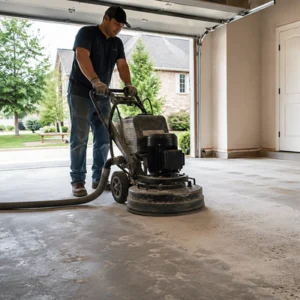
Grinding, shot blasting, or scarifying roughens the slab so coatings can bond better.
Cracks are cleaned, filled, and checked before coating, but slab movement can still show.
The coating system starts with primer and epoxy base coat for strong floor coverage.
Decorative flakes improve the look of the floor and can help increase grip.
A topcoat helps protect against wear, stains, sunlight, moisture, and daily use.
The floor must cure before foot traffic, storage, or vehicles are allowed back in.
The contractor checks the concrete for cracks, stains, weak spots, spalling, and old coatings. Bad concrete must be fixed before coating.
Concrete can release moisture vapor. ASTM F1869 and ASTM F2170 are common test methods used to check slab moisture. Test results show the slab condition at the time and place tested.
Ground, shot blasted, or scarified ground. This roughens the concrete surface so that the coating can bond better. Inadequate preparation is a primary cause of coating failure.
Clean, fill, and check cracks before coating. But a coating can still reflect slab movement. Repair counts.
The coating system forms the basis for applying a primer and epoxy base coat.
Decorative flakes can help add to the look and increase grip .
A topcoat protects the floor from wear, stains, sunlight, and moisture.
The floor must cure before foot traffic, storage, or vehicle traffic. Rushing this step can damage the finish.
No, not without proper checks and repair. Cracks and moisture are two of the biggest risk points for garage floors.
If the slab has too much moisture, the coating may blister, peel, or lose bond. ASTM F3010-24 and ASTM F3513-24 cover moisture mitigation systems used over high-moisture concrete before certain floor coverings. For garage coatings, the installer should also follow the coating maker’s moisture limits.
Ask these questions before hiring anyone:
For most standard residential garage floor coatings, the City of Fort Worth says cosmetic floor coverings do not need a permit. Structural slab repair, foundation work, or drainage changes may be different.
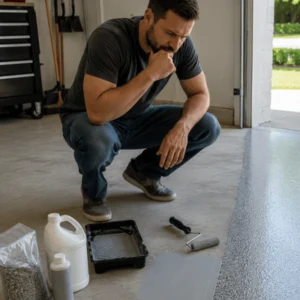
A DIY kit might seem cheaper, but it has real limitations. Most failures are caused by bad concrete preparation or ignoring moisture.
DIY kits might be good for a quick pick-me-up. Not so good for a busy garage which has cars, tools, heat, rainwater, and heavy storage.
Professional installation is often better when you want:
The 2026 U.S. Houzz & Home Study reports that median planned renovation spend dropped to $15,000, down from $20,000 in 2025. Budget matters. Still, removing a failed coating and starting over can cost more than doing it right the first time.
A well-installed epoxy garage floor can last for many years. Lifespan depends on prep, moisture control, traffic, and topcoat choice. Floors usually fail early when the slab is not tested or prepared well.
Yes. Certain coatings may be impacted by intense heat and sunlight close to open garage doors. A topcoat that is UV-stable aids in finish protection. Additionally, it lessens wear and fading.
When wet, smooth epoxy may become slick. Texture additives or dispersed flakes can improve grip. If precipitation gets into your garage, ask your installer about slide resistance.
Epoxy can improve the surface, but it won't prevent concrete from shifting. Cracks should be examined and repaired prior to coating. There may still be some visible fissures if the slab moves later.
In Fort Worth, a home permit is typically not required for a simple cosmetic floor covering. Structural slab work is not the same. Find out if the project involves repairs other than coating by contacting the city or your contractor.
Epoxy provides a good build and a firm binding. Polyaspartic is more UV-resistant and cures more quickly. Epoxy serves as the foundation for many systems, with a polyaspartic or polyurethane finish providing further protection.
An epoxy garage floor in Fort Worth is a smart upgrade when the slab is prepared the right way. The best floors start with testing, grinding, crack repair, and a topcoat made for real garage use. To learn what your concrete needs are, get a free quote from Floor Doctor today.