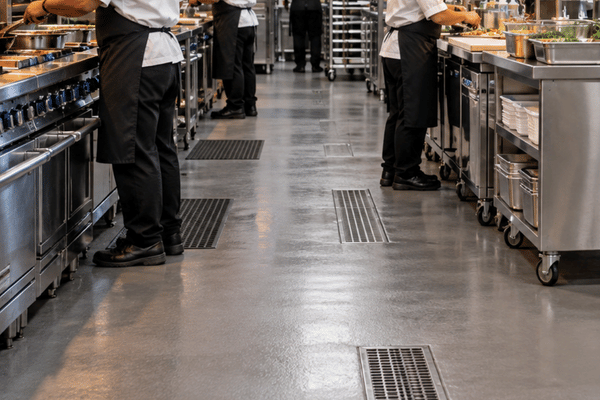
A restaurant kitchen floor has a rough job to do. It gets hit with grease, water, dropped tools, hot equipment, carts, and constant cleaning. In a single service, the same square foot of floor can take scalding wash water at the dish pit, a cold spill from a walk-in, a loaded rack cart, and a caustic degreaser at close.
Good commercial kitchen flooring should be easy to wash, safe for staff, and suited to the way the kitchen runs. It also needs to meet Texas food rules and any added local requirements.
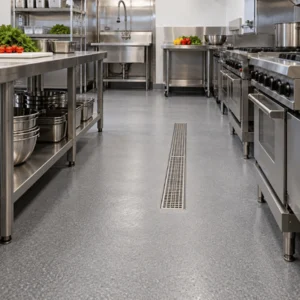
Texas restaurants follow the Texas Food Establishment Rules, which sit in Title 25, Chapter 228 of the Texas Administrative Code. Under 25 TAC 228.1(b), the Department of State Health Services adopts the FDA Food Code 2017 and its Supplement by reference. That version took effect on August 8, 2021. Where Texas law and the adopted Food Code conflict, 228.1(d) says Texas law and Chapter 228 prevail.
Those rules focus on keeping food areas clean and sanitary. In most kitchen work areas, the floor should be:
Some areas need more than that.
If a kitchen floor is cleaned by flushing it with water, proper drainage is important. The floor also needs enough slope for the water to reach the drain.
Utility lines matter too. Pipes and other lines should not block cleaning. Horizontal lines should not run across the floor.
Carpet does not belong in food prep areas, warewashing spaces, walk-in coolers, or other wet zones.
Local rules can be stricter than state rules. Before installing a new floor, check with the local health department.
There is no one material that works best in every restaurant.
The best flooring for commercial kitchen use depends on the space. A dish area has different needs from a dry storage room. A busy cook line also sees more grease, heat, and traffic.
Here are some common options:
| Flooring Type | Why Owners Use It | What to Watch |
| Quarry or ceramic tile | Handles moisture and heat well | Grout needs care |
| Terrazzo | Strong and long-lasting | Costs more to install |
| Sealed concrete | Simple and practical | Needs the right sealer |
| Resin coating | Easy to wash and has fewer joints | Slab prep matters |
Tile is still common in restaurant kitchens. It can handle daily use, but cracked grout can become hard to clean.
Resin coatings remove many of those grout lines. That makes routine washing easier in busy prep and cooking areas.
Zone-based selection is more practical than building-based selection. Many kitchens end up with two systems: a heavy-duty one for the hot and wet areas and a lighter one everywhere else. These four issues are dry storage, the dining floor, prep, and the dish pit.
Commercial kitchen epoxy flooring can be a good choice when the right system is used.
It works well in spaces that need a coated floor that can handle regular wear.
Some of the main benefits include:
The coating itself is only part of the job.
Concrete often needs grinding, cleaning, crack repair, and moisture checks first. Poor prep can lead to peeling, bubbling, or weak bonding later.
Not every epoxy product is made for restaurant use. The product should match the heat, moisture, cleaning chemicals, and traffic in that space.
Some polyurea and polyaspartic systems cure faster than standard epoxy. That can help when a restaurant wants to limit closure time. In a hot, wet kitchen, they are more often specified as a fast-curing topcoat over a body coat than as the entire system.
Kitchen floors often get wet. Add grease, and the risk of slipping goes up fast.
That is why non-slip commercial kitchen flooring needs careful planning.
A contractor may improve grip by:
OSHA requires work floors to be kept clean and as dry as possible. It does not set one friction number for every restaurant floor.
The specific rule is 29 CFR 1910.22(a)(2), which states that the floor of each workroom is maintained in a clean and, to the extent feasible, dry condition, and that when wet processes are used, drainage must be maintained and, to the extent feasible, dry standing places such as false floors, platforms, and mats must be provided. Section 1910.22(a)(3) adds that walking and working surfaces be maintained free of hazards, including spills.
A floor can also be too rough.
Heavy texture may trap grease and make washing harder. The better choice is a finish that gives staff enough grip without making cleanup a chore.
Mats sit inside the code as well. Under Food Code 6-201.15, they have to be removable and easily cleanable, so a mat that cannot be lifted and washed is a finding waiting to happen rather than a safety measure.
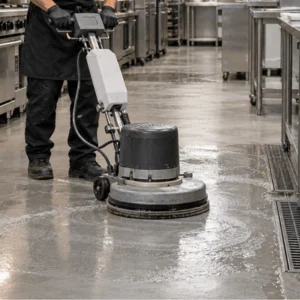
A good floor starts with the concrete below it.
The work may include:
Cure times are not the same for every product. Some fast-cure systems can return to use sooner than standard epoxy.
After the floor is installed, regular care makes a big difference.
Clean grease and spills quickly. Use cleaners approved for the coating. Rinse enzymatic degreasers thoroughly, since it is the residue left behind that turns into oleic acid and goes after grout and some coatings.
Check busy areas often and repair small damage before it gets worse.
One last maintenance note. If you see standing water in the same low spot after every wash down, that is a grading problem, not a cleaning problem. It is both a slip risk and an inspection issue, and no amount of mopping fixes it.
Resin coatings, sealed concrete, terrazzo, and tile can all be used. Moisture, heat, traffic, cleaning, and budget all influence the best decision. Local code is important as well.
Yes, if the system is compatible with the available space. Compared to tile, epoxy can provide kitchens with a coated surface that is more durable and has fewer joints. Just as crucial as the coating itself is proper preparation.
Texas requires food-area floors to be smooth, durable, and easy to clean. Wet areas need materials that do not absorb moisture. Some areas also need proper drainage and slope.
A kitchen floor should stay safe when water or grease is present. Texture, mats, drainage, and fast cleanup can all help. OSHA focuses on keeping walking areas clean and as dry as possible.
There is no set lifespan for every kitchen floor. Traffic, heat, moisture, cleaning, and prep all affect how long it holds up. Good maintenance can add years to its service life.
Yes. Quarry and ceramic tile are both common in restaurant kitchens. The main drawback is grout, which needs regular cleaning and repair.
A restaurant floor should make daily work easier, not harder. It needs to stand up to cleaning, spills, traffic, and the demands of each work zone.
Floor Doctor installs epoxy and concrete coating systems across Central Texas. Get a quote today to find a floor system that suits your kitchen and daily workload.